
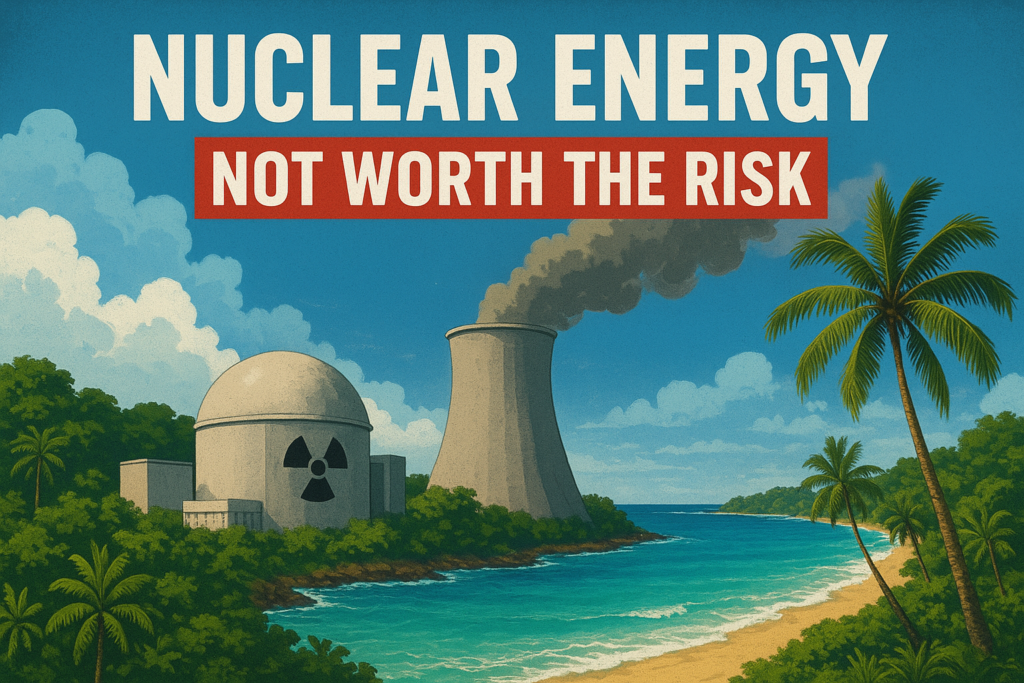
As I continue reflecting on the energy transition in the Caribbean, I wanted to explore whether nuclear technology presents a viable option for the region. Building on my earlier post, this piece examines the practical, economic, and social factors that make nuclear [power] less appropriate compared to the region’s abundant renewable resources.
A region’s preferred energy source is often determined by what is most abundant and readily accessible. For Caribbean nations, this naturally means solar, hydropower and wind. Nuclear energy, despite its high generating capacity in larger countries, remains unused in the region.
Nuclear energy is produced by splitting atoms to generate heat, which boils water and spins a turbine to produce electricity. Although this process is common in many European and Asian countries, nuclear technology is not currently a viable or appropriate option for the Caribbean’s regional energy transition.
Firstly, while the Caribbean is rapidly developing and increasingly in need of stable electricity, the region already has much cheaper and more accessible clean energy options. Solar, wind, hydro and geothermal power can be deployed with far fewer financing, regulatory and legal hurdles than those associated with acquiring nuclear fuel, managing long-term waste, or constructing and operating a nuclear reactor. The capital required to establish a nuclear industry in the Caribbean would yield far greater benefits if invested in scaling existing renewable energy technologies.
Secondly, nuclear power is designed for countries with large populations and substantial capacity needs. Most Caribbean nations [have much lower energy needs] than countries such as France or the United States, which have hundreds of millions of residents. For small island states such as those within CARICOM, nuclear energy would be disproportionately large, expensive and operationally inefficient.
Social acceptance is another significant factor. Caribbean residents are already disproportionately affected by extreme weather and climate-related disasters. Public attitudes in the region tend to favour risk-averse approaches to infrastructure. Historical nuclear accidents such as Chernobyl continue to shape global public perception and would likely make community approval difficult to obtain. This resistance is amplified by the fact that the Caribbean has multiple abundant, cost-effective and lower-risk renewable energy options that can meet the region’s needs without introducing unnecessary hazards.
For these reasons, while nuclear energy is a powerful and important global technology, it is neither viable nor appropriate for the Caribbean’s current energy transition pathway.
27 November 2025
Sherida O. Hinckson-Johnson
University of Guyana
MSc Oil & Gas and Renewable Energy Candidate