
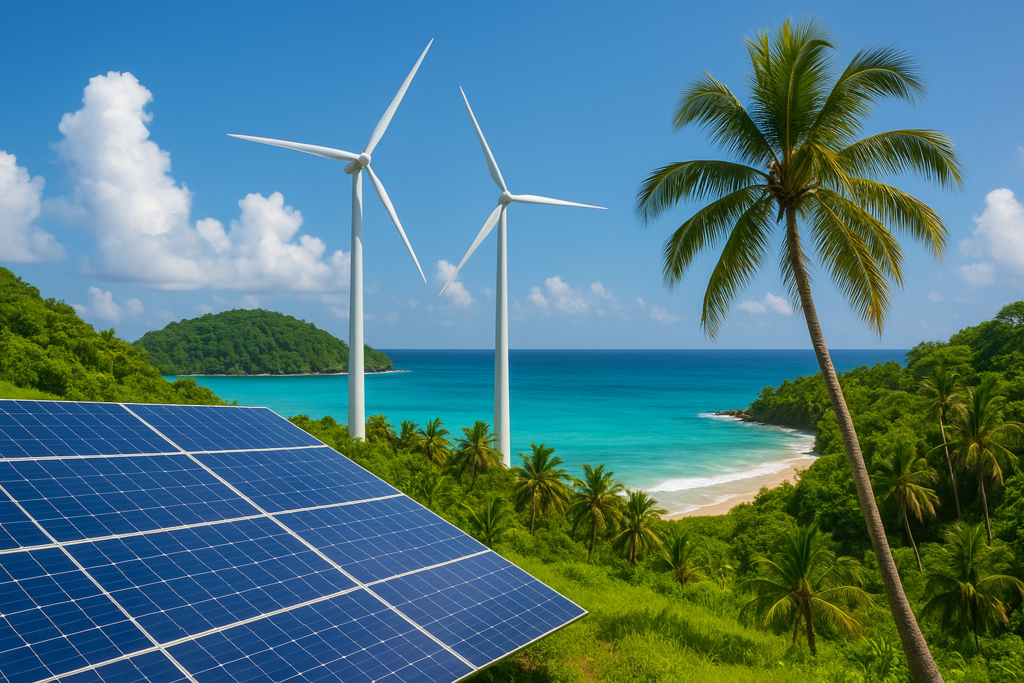
This semester, I was challenged to think deeply about some of the biggest questions shaping the future of energy in the Caribbean. As part of my midterm exam for my Sustainable Energy and Development course, I was asked to analyse how the region can leverage its unique geographic, economic, and social characteristics to accelerate the global energy transition — and the challenges and opportunities that come with it.
This was my first full semester in grad school, and I’m genuinely proud of the clarity and confidence I’ve developed in my thinking. I don’t always give myself the time to write, but when I do, I’m reminded of how much I love it and how naturally reflective I am. I know that writing will be a big part of my journey, and I hope to publish many pieces in the future as I develop my position as a thought leader.
Energy, equity, and education are the pillars of the brand I’m building, and sharing my reflections is one way I hope to contribute to the wider conversation. Here are some of my thoughts on the question above, shaped by what I’ve learned so far and where I’m growing next.
The Caribbean region, which is abundant in natural resources, ripe for investment and national development, and accessible through a largely neutral social landscape, is uniquely positioned to lead and accelerate the global energy transition.
Countries such as China and the United States have led the transition not simply because of resource availability, but because they have had the funding to develop and deploy the technologies that harvest clean energy. That said, money is only one of the tools needed to push the world toward a sustainable energy future.
Solar, wind and hydropower, which are the three most common forms of renewable energy, are all found in abundance across the Caribbean. This direct access to multiple renewable sources means that countries in the region do not need to rely solely on imported fuels, nor must they depend on just one type of clean energy. Guyana and Jamaica, for example, benefit from high solar exposure, inland and coastal waterways, and consistent sea breezes. In contrast, countries outside the region may have fewer hours of sunlight, less access to hydrological resources, or may be landlocked and unable to harness coastal wind power.
Economically speaking, tourism remains one of the largest contributors to the region’s GDP. Caribbean nations could leverage this by expanding what [efforts] tourism revenues can fund. Ministries of tourism could establish systems that require that a portion of tourism revenue be allocated to renewable energy projects, which would likely resonate with the millions of visitors per year whose interest in sustainability, ecotourism and climate action continues to grow.
The same model applies to the Caribbean’s natural resources and agricultural industries. While these sectors may contribute less to GDP than tourism, directing even a fraction of their earnings toward expanding clean energy technology portfolios could support self-funded progress in the transition.
Socially, the region’s largely neutral geopolitical posture, which is marked by limited involvement in major conflicts such as wars or sanctions, creates an environment that can be more attractive to foreign investors. Compared to regions with complex political risks, the Caribbean’s social stability reduces reputational barriers to investment in national development and clean energy.
Despite these advantages, several challenges remain. Renewable energy technologies are still expensive, and many Caribbean nations lack the resources to self-finance rapid deployment. Furthermore, until battery energy storage systems can be deployed at a scale sufficient to absorb and distribute the energy generated, the full potential of renewables cannot be realised.
Existing grid infrastructure presents another obstacle. Most grids in the region were designed for fossil fuel-based systems. Large-scale modernisation, which would likely cost hundreds of millions of US dollars, will be required for efficient integration of renewable technologies. While similar upgrades have already occurred elsewhere, Caribbean nations generally lack the financial capacity and access to capital to undertake such work.
Workforce capability is an additional constraint. Although millions of people live within the region, the technical skills required to build, install and maintain renewable energy systems are still developing. As a result, overseas companies implementing these projects often bring in their own technicians, meaning that renewable energy development tends to create more jobs for foreign workers than for locals.
Even with these challenges, the Caribbean still has a unique opportunity to lead as a renewable energy adopter precisely because it is an underdog. The region is home to some of the world’s most valuable ecological assets, including coral reefs and critical biodiversity systems, while the majority of global emissions originate elsewhere. Caribbean nations could leverage carbon credit markets to generate revenue for renewable deployment. Additionally, as late adopters, they can bypass certain hurdles faced by early adopters, such as building public awareness from scratch or securing societal buy-in for renewable energy investment.
27 November 2025
Sherida O. Hinckson-Johnson
University of Guyana
MSc Oil & Gas and Renewable Energy Candidate